GODZILLA FIELD REPORT No. 2
Seven themes for understanding Godzilla (and therefore, ourselves)
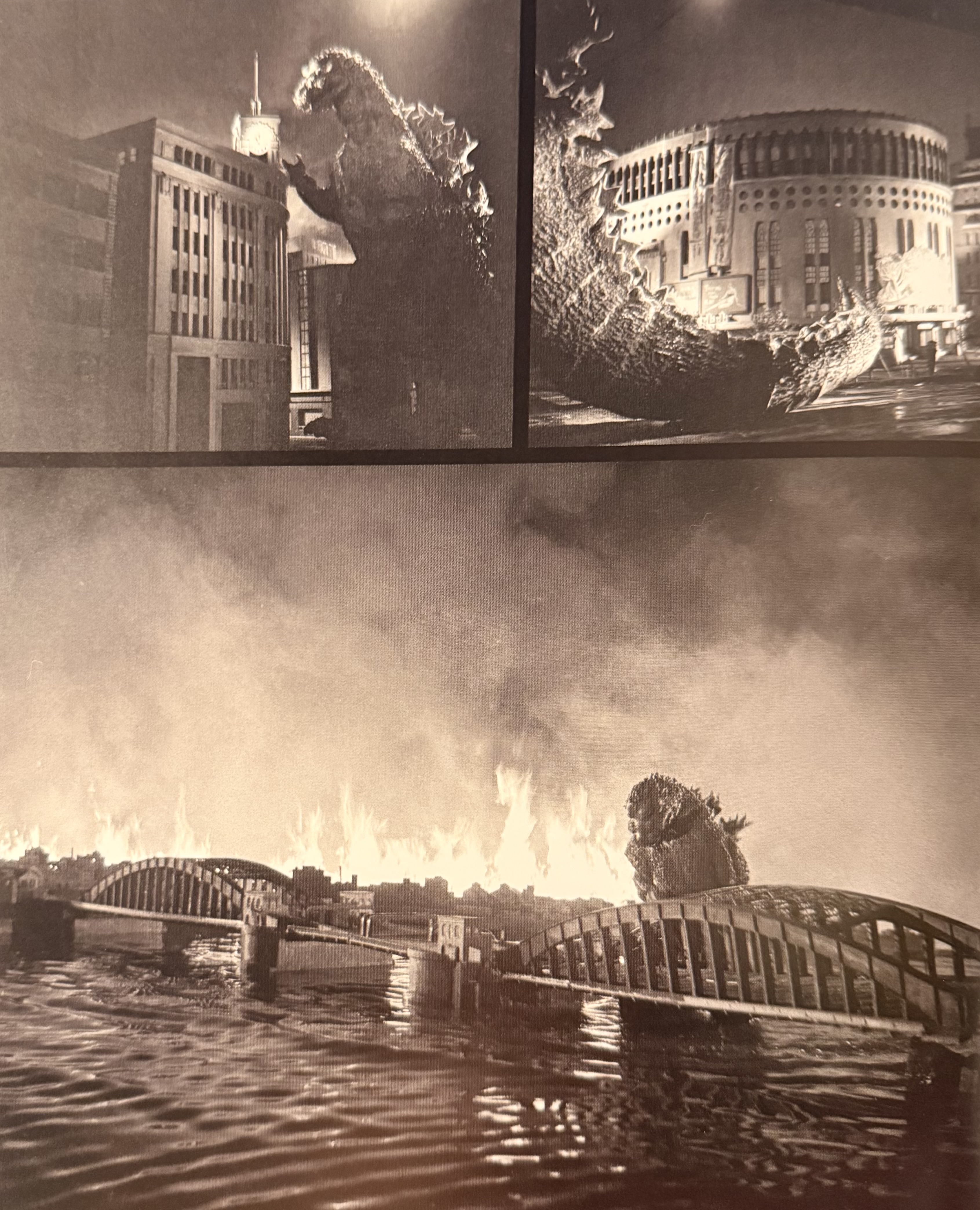
New to the Mission? Start Here: Mission Kaiju_Love_Care_Futures_02026 Site Index
INCOMING TRANSMISSION / / /
We are pleased to share that, from our point of view, the mission is off to a promising start. We were glad to hear that the Press Release was well-received. As you know, Field Researchers rarely get the same view as Mission Headquarters, so we are grateful that you would take the time to share this with those of us at the Godzilla Field Office.
So far, we’ve received no correspondence at the thegodzillapapers@gmail.com inbox you so generously set up for the mission. We do hope that as this mission gains traction, we hear from other Godzilla scholars and citizen-scientists.
Still, even in the silence, we must press on!
What follows are notes from our most recent readings, mostly having to do with Godzilla (1954). You will find in these notes seven themes through which we might view our work.
Please: do not be dismayed at the choppy writing. This is—after all—a Field Report. We are transcribing our thoughts quickly and without self-censorship so as to compile material to be made sense of at a later date. We trust you will inform the Chief of Mission if you find our process unsuitable.
GODZILLA FIELD REPORT No. 2
Date: March 07, 020261
Location: Brooklyn
Mission: Kaiju_OrgLearning_Facilitation_KM_02026
Artifacts Examined: Pages 1 - 37 of Ryfle, S., Godziszewski, E., Carpenter, J., Odaka, M., & Tomiyama, S. (2025). Godzilla: The First 70 Years: The Official Illustrated History of the Japanese Productions. Abrams Books.
Sections examined include:
Foreword, John Carpenter
Foreword, Megumi Odaka
Godzilla (1954), Chapter One of Part One: Beast of Burden: 1954 to 1975
Research Soundtrack: Akira Ifukube, Godzilla Original Motion Picture Soundtrack
Rations Consumed: two espresso2, one apple, half a bowl of cereal.
Chief of Mission (AKA Dudley the Dog) Present? Yes.
THE (PROPOSED) SEVEN THEMES FOR UNDERSTANDING GODZILLA (AND OURSELVES)
- Mission alignment
- Nothing means anything without its context
- Absolutely insane logistics can make the impossible possible
- Multiple things can be true at once
- Everything is political
- There are many ways to play a piano
- We should not underestimate the power of ritual
THEME 1: MISSION ALIGNMENT
As we begin to explore the philosophy and historical context of Godzilla (1954), we are finding many parallels between the film and our mission. This is encouraging, considering the amount of public buy-in we will need as we aim to make the Godzilla Field Office a more sustainable operation:
On page 12, in the Introduction of The First 70 Years, Ryfle and Godziszewski offer:
“Godzilla has consistently held up a mirror to the changing world, offering a cautionary tale about not only nuclear war, but also capitalist greed, environmental destruction, exploitation of Indigenous peoples, the Cold War, nationalism, U.S-Japan relations, and more.”
We know that some at Mission Headquarters had concerns that ours is a frivolous endeavor. We would urge them to understand that Godzilla is a monster for our time—a time of genocide3, rising authoritarianism, and disregard for our planet. In other words: this mission could not be less frivolous.
According to Kimi Honda, Godzilla Director Ishiro Honda’s wife, “… the backstage boys at Toho loved to joke around with tall stories.” This is another point of alignment, seeing as the boys here at the Godzilla Field Office also love to joke around with tall stories.
When thinking about how to make a monster movie that might be taken seriously, the team behind Godzilla (1954) decided that “… they would depict a giant monster attack with the seriousness of a documentary.” We hope those at Mission Headquarters (as well as the general public) understands that this is exactly what we’re trying to accomplish with this Mission.
THEME 2: NOTHING MEANS ANYTHING WITHOUT ITS CONTEXT
Godzilla is an allegory for atomic power, war, and grief. In discussion, many of us offered that the film and its production are incredible ways to process the bombings of Hiroshima and Nagasaki, the war in general, continued nuclear testing, and the process of rebuilding.
Ryfle and Godziszewski provide some important context to help us understand what was happening in Japan in the years leading up to Godzilla:
We have talked about this at length, and the boys over at HQ might groan, but we believe it’s worth repeating: we cannot understand anything without its context. Whether we are thinking about organizational learning, facilitating a hard conversation, or understanding a monster movie, we cannot divorce the object of our focus from its context.
And context isn’t theoretical! The people who worked together to make Godzilla fought in the war and witnessed firsthand the destruction of cities and their people.
There’s something about this context that gives Godzilla its tragedy and its poignancy: there’s a futility to fighting him. Director Ishiro Honda said,
“If Godzilla had been a dinosaur or some other animal, he would have been killed by just one cannonball. But if he were equal to an atomic bomb, we wouldn’t know what to do. So, I took the characteristics of an atomic bomb and applied them to Godzilla.”
THEME 3: ABSOLUTELY INSANE LOGISTICS CAN MAKE THE IMPOSSIBLE POSSIBLE
Godzilla wasn’t even an idea until sometime in March of 1954. In the midst of a failed project5 and major uproar about nuclear testing6, Producer Tomoyuki Tanaka came up with the idea for “a big monster near Bikini which was awakened by the shock of hydrogen bomb testing” who invades Japan. So he starts to get a team together. They figure out the script, the ideas, etc., and on July 5, 1954, Toho Studios announced the then-mysterious project as G Project. The movie premiered on October 27, 1954 and was widely released across Japan on November 3, 1954. That’s 121 days between official project annnoucement and release. If Toho could make Godzilla this quickly, then surely philanthropy can mobilize millions of unrestricted dollars and capacity support to folks who need it in far less time.
The special effects team was incredible. We will explore this with more depth in future Field Reports, but suffice to say: Eiji Tsuburaya had experience making miniature sets for government war films, and led an incredibly talented team as they designed and built scale models of Tokyo. Apparently, some of the young team members (who—at that point at least—weren’t credited on the film) would eat and sleep at or near Toho Studios to get the building done in time for shooting. So: not great in the workers’ rights arena. Philanthropy can move resources more quickly, but this is perhaps not the exact model we should embrace.
All I’m saying is: ambitious timelines are possible (even without worker exploitation!). Philanthropy is often being asked to do things that are far less complicated than (quickly) building a miniature, to-scale version of Tokyo for a man in a monster suit to destroy.
THEME 4: MULTIPLE THINGS CAN BE TRUE AT ONCE
On page 31 of The First 70 Years, Ryfle and Godziszewski point out something that we encourage our colleagues working in Knowledge Management and Organizational Learning should keep in mind:
“Mythical and rational explanations for the monster’s existence are provided by the Odo Island wise man (Kokuten Kodo) and Dr. Yamane. Neither story is truer than the other, and the scientist names the monster after the islanders’ folk legend.”
An increasing number of institutions, practitioners, and others are advocating for and implementing different, more human approaches to how we understand social change work. As you know, we at the Field Office often invite folks to embrace multiple truths.
We propose that we keep this in mind when we arrive to the synthesis phase of our mission.
THEME 5: EVERYTHING IS POLITICAL
As you know, the next artifact for review is Godzilla: King of the Monsters! (1956).
This is an Americanized version of the original Godzilla, and we must be frank: none of us are thrilled about this. It should come as no surprise that we are as far from being neutral Researchers as Godzilla’s nose is from his feet.
Ryfle and Godziszewski give us an overview of how this abomination7 was made after an American studio bought the rights:
“More than one-third of the original film was excised; scenes were shortened or deleted altogether, including key references to the atomic bombing of Japan, Godzilla’s relationship to hydrogen bomb testing, and political squabbles over whether to make this information public. Notably, Dr. Yamane’s final speech about the dangers of nuclear testing and the likelihood of another Godzilla was removed, and the American cut ends with Burr instead declaring that “the whole world could wake up and live again.”
Because the film arrived in theaters at a time when the US and USSR conducted hundreds of hydrogen bomb tests, these changes to the film have fueled speculation that the American distributors neutered the antinuclear message for political reasons. “No,” responded producer Richard Kay. “We weren’t interested in politics, believe me. We only wanted to make a movie we could sell.” Kay noted that the film was released just eleven years after World War II. “At that time, the American public wouldn’t have gone for a movie with an all-Japanese cast. That’s why we did what we did. We didn’t really change the story. We just gave it an American point of view.”
BRO. This is the very PICTURE of a political decision.8
How very American. How arrogant. To say: No, no, no, let us tell the story. You’ve got it wrong.9 We’ll remove nearly all of the context to make this work palatable and sellable.
We will review Godzilla: King of the Monsters! for mission continuity, but we will do so at great risk to our health. That said, we believe in this mission and will do what it takes to stay on track.
THEME 6: THERE ARE MANY WAYS TO PLAY A PIANO
As noted above, we have been listening to Akira Ifukube’s brilliant work on the Godzilla Original Motion Picture Soundtrack while compiling these notes. Below is a note from Ryfle and Godziszewski about the making of some of the sounds in the score:
“Using snarling brass and low-pitched instruments such as a contrabassoon, the music accompanying Godzilla’s attacks is distinguished by its series of rising notes, starting on C#, which highlights the monster’s towering height. The steady rhythm of this music is punctuated by thunderously dissonant tone clusters from the piano, which are executed by crashing down on the instrument’s lowest-pitched white and black keys with both forearms. The effect reminds the audience of Godzilla’s weighty, shattering footfalls as it advances relentlessly across the city.”
Our mission has much to learn from this creativity: there are many ways to work. There are many ways to learn! There are many ways to think.
What we’re saying is: sometimes, to do their best work, people need the creative freedom and ability to “crash down on the instrument’s lowest-pitched white and black keys with both forearms.”
Or to stomp around as if they are Godzilla.10
THEME 7: WE SHOULD NOT UNDERESTIMATE THE POWER OF RITUAL
After Godzilla production wrapped, Toho Studios gave Godzilla a funeral.
…The film’s lead actors, Akira Takarada (Ogata) and Momoko Kochi (Emiko), joined by the (empty) Godzilla suit, rode through the streets of Tokyo in the back of a truck, waving to a bemused public along their route.
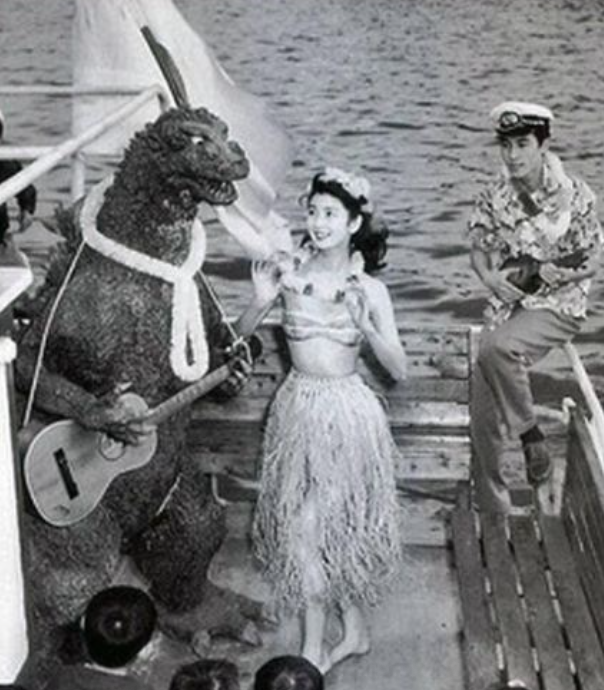
Rituals are important. Play and whimsy are important, especially now. As you know, we have been exploring various ways to bring play and whimsy to our facilitation and consulting work outside of this mission. While we do understand that the mandate of this mission is decidedly not playful or whimsical,12 we believe we can learn from Toho’s commitment to ritual.
We hope these themes offer some windows into how we might learn about organizational learning, facilitation, collaboration, and knowledge management in the social sector. We should note, too, that we are beginning to wonder if we might expand our scope: we believe that the Godzilla franchise can teach everyone about love, care, and building a future that works for all. This is not an official scope change request—we know there are forms for that. This is simply a peek into our thinking. We hope those of you at Mission HQ will keep an open mind.
During our next artifact review, we will assess whether these themes might support an analytical framework for the eventual synthesis of these Field Reports.
With respect, we must share that the Chief of Mission has not been very engaged. Whenever we request input, he is either snoring or chewing on a plush platypus. We acknowledge that the problem here may be our timing.
While morale has been high, we admit that morale is waning as we head into our review of Film Artifact 3: Godzilla: King of the Monsters!. As a sign of commitment to knowledge and learning, we will press on and look forward to returning to the Japanese productions.
Rations are still well-stocked, though we could use another shipment of popcorn.
Yours in Science13,
The Godzilla Field Office Team
POSTSCRIPT: SABOTAGE TRACKER
In your last note, you expressed concern about the threat posed to our mission by the man who happens to live here at the Godzilla Field Office. We appreciate your concern, and we will keep you apprised of any new developments. We have designated several pages in the Mission Log to a “Sabotage Tracker” so we will be able to track patterns and assess the threat in real time. We will include these in a Sabotage Tracker section of this and future Field Reports:
March 07, 02026:
- 06:47 man moves Godzilla: The First 70 Years out of Assistant Researcher’s reach. Many of us are settled among our research materials, covered in blankets and/or the Chief of Mission’s sleeping body, and cannot move quickly enough to retrieve the artifact.
- 06:50 man returns the artifact, but as he does so, he reaches to steal the mission log. When he fails to do so, he steals Lead Investigator’s pen.
Please advise with any information that may help us counter this behavior. We don’t believe this is a dire threat (yet), but we hope to be prepared to protect the mission if needed.
END OF TRANSMISSION / / /
Seed & Signal™ taught the Mission Team this Long Now formatting. Mission supporters are encouraged to subcribe. ↩
espressos? do we have a coffee taxonomist on staff at HQ? ↩
Free Palestine. ↩
Note in the margins of mission logbook: “god damn, we are always at war.” ↩
In March of 1954, Producer Tomoyuki Tanaka was trying to make In the Shadow of Home or In the Shadow of Glory. We haven’t had the capacity to look into this deeply yet (which is why this is a footnote), but this is our understanding so far: Tanaka was trying to make what sounds like an anti-imperialist film about a Japanese Imperial soldier who joins Indonesia’s fight for independence, but the film couldn’t be made because of disagreements between the two governments about colonial war reparations. Note in the margins of mission logbook: “WOW” ↩
The U.S. had just detonated the 15-megaton Castle Bravo hydrogen bomb at Bikini Atoll in the Marshall Islands, which had especially devastating impacts on the crew of Lucky Dragon No. 5, a Japanese commerical fishing vessel. ↩
We know: we haven’t seen it yet, but we are already mad. EDIT: we’ve seen it, and we hate it. Will elaborate in a future Field Note. ↩
Forgive us for the unprofessional language. The Chief of Mission is snoring, he cannot proofread and therefore we are on our own. If necessary, please translate before distribution. ↩
You’ve got a story inspired in part by what WE did (and what we keep doing) completely wrong. Classic bully megalomaniac behavior. (Chief of Mission still not paying attention). ↩
Something occuring with increasing frequency here at the Field Office. ↩
It was a publicity stunt. We don’t care, we think it’s lovely. ↩
wink wink ↩
This mission is dedicated to the memory of Harvey Rowe. ↩