GODZILLA FIELD REPORT No. 7
Five lessons for humanity about the violent nature of borders, the risks of jumping out of planes, believing folks’ experiences, the power of collective action, and collective responsibility.
New to the Mission? Start Here: Mission Kaiju_Love_Care_Futures_02026 Site Index
INCOMING TRANSMISSION / / /
We were pleased to hear the news of the Mission’s inaugural Board Member. Though this isn’t exactly what we asked for in our last Field Report, it is a promising development. We will refrain from striking—for now. We will, per your instructions, prepare a postcard.
We do hope you can recruit more Board Members1.
What follows is our Field Report exploring the lessons in Ghidorah, the Three-Headed Monster (1964). As you might infer based on the contents of this Report, Julije Morrison, Political Analyst took the lead here. You will notice the dearth of quotes pulled from various political scholars and historians. While readers may think this Report includes too many quotes, believe us: the first several drafts contained many more quotes and commentary in caps lock.
When asked if they wanted to offer a note of grounding to the Mission’s readers, Mx. Morrison—without looking up from their desk—muttered: “Buckle up.”2
GODZILLA FIELD REPORT No. 7
Date: April 10, 020261
Location: Brooklyn
Mission: Kaiju_Love_Care_Futures_02026
Artifacts Examined:
Ghidorah, the Three-Headed Monster (1964)
Pages 84 - 97: Ghidorah, the Three-Headed Monster, Chapter One of Part One: Beast of Burden: 1954 to 1975 of Ryfle, S., Godziszewski, E., Carpenter, J., Odaka, M., & Tomiyama, S. (2025). Godzilla: The First 70 Years: The Official Illustrated History of the Japanese Productions. Abrams Books.
Pages 44 - 51: Godzilla: King of the Monsters! (1956), of Skipper, Graham. (2022). Godzilla: The Official Guide to the King of the Monsters. Welbeck Publishing.
Rations Consumed: five espressos, a banana, an apple, a ziploc full of smoked almonds snagged from a local restaurant.
Writing Soundtrack: (Nothing But) Flowers by the Talking Heads
Chief of Mission (AKA Dudley the Dog) Present? Yes
Ghidorah, the Three-Headed Monster is the first film in which we see Godzilla becoming a reluctant ally to humanity. While we believe that this is a positive development, we should be clear: it’s not that Godzilla is particularly excited about being helpful.
Godzilla scholars Ryfle and Godziszewski note:
The monster was not yet truly a hero—it still held no sympathy for humankind, but it was now sworn to protect its homeland from outside threats as a reliable unpredictable guardian. - Page 91, The First 70 Years
A reliable, unpredictable guardian, indeed. Much like our Chief of Mission, Dudley Cramblin.
In this report, we offer five lessons for humanity about the violent nature of borders, the risks of jumping out of planes, the importance of believing folks’ experiences, the power of collective action, and collective responsibility.
LESSON FOR HUMANITY No. 1: Borders Are an Absurd, Violent Construct
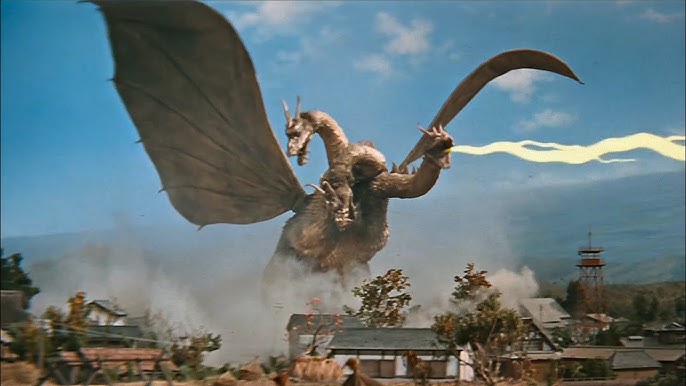
King Ghidorah—a three-headed, two-tailed flying monster from space—is not just Japan’s problem. He’s a problem for the whole world (as it turns out: he’s a problem for other worlds, too).
Kaiju have no reason to respect borders.
We believe that since Kaiju are ancient, living ancestors, they necessarily have a different political grounding than many of us humans. Their time scale is much longer than ours. Not only have they seen borders change—they have mostly known a world without nation-states or borders.
Borders are a modern and violent invention.
As Harsha Walia states in Border & Rule: Global Migration, Capitalism, and the Rise of Racist Nationalism:
In contrast to the inaccurate framing “We are a nation of immigrants,” the more subversive chant “We did not cross the border, the border crossed us” destabilizes the southern border by interrogating the assumption of “migrant” on seized lands and exposing the hypocrisy of colonizers calling people “illegals.” Subjugated communities, particularly Indigenous and Black (importantly, not mutually exclusive), are often folded into the liberal narrative of “racial minorities.” Further, Indigenous decolonial and Black abolition struggles are largely seen as disconnected from the immigrant rights movement, except in identifying shared struggles against racism. However, the war on migrants does not exist separate from or simply parallel to anti-Indigenous and anti-Black violence. Early US bordering practices were, in fact, conceived of as a method of eliminating Indigenous people and controlling Black people, and US border imperialism is structurally bound up in these genocides. - Page 23, Border & Rule
Movement across lands is natural (for humans and for Kaiju). Borders are not.
What might our shared futures look and feel like if we rejected the violent construct of borders and settler violence? A question for the Arts Department, we suppose.
LESSON FOR HUMANITY No. 2: Be Advised That When Jumping Out of a Plane to Escape an Assassination Attempt, the Spirit of a Venusian Might Borrow Your Body for Their Advocacy Campaign
Early in the film, we meet Princess Salno of Selgina while she is en route to Japan. We quickly learn that her government is planning to assassinate her by blowing up her plane. (!)
Seconds before the explosion, she hears in her head an otherworldly voice that instructs her to jump from the aircraft. When she reappears in Japan, she is wearing a fisherman’s clothing and announcing the Kaiju Rodan’s impending arrival to a crowd of people.
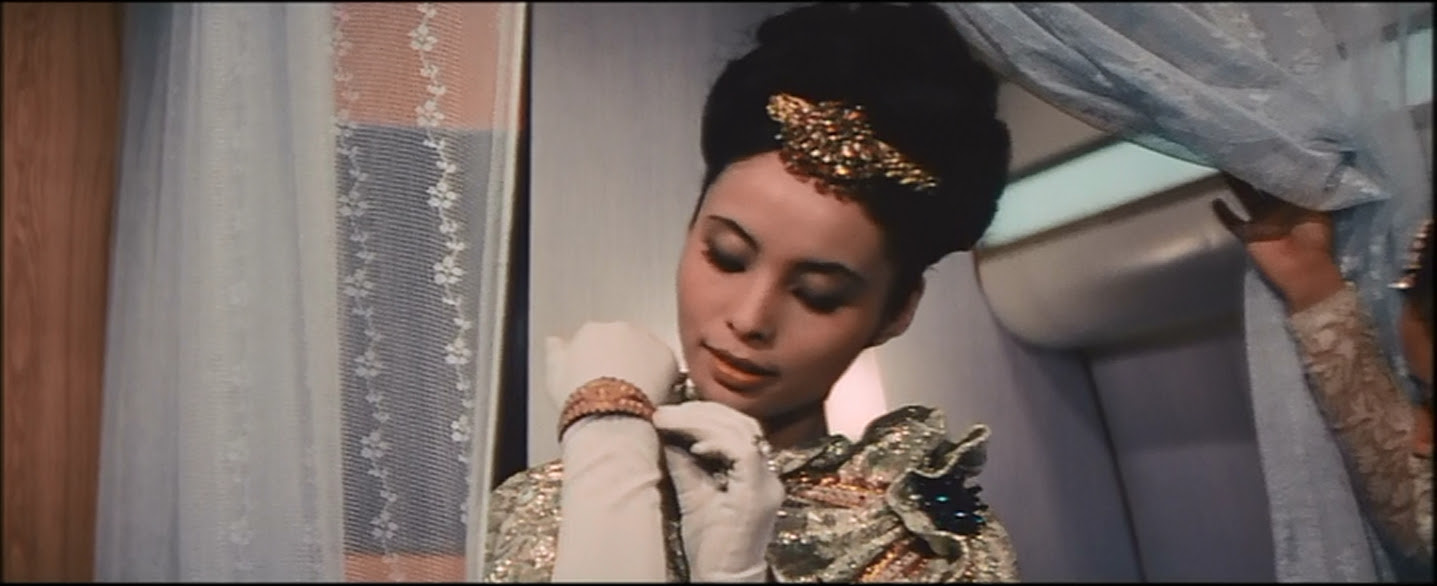
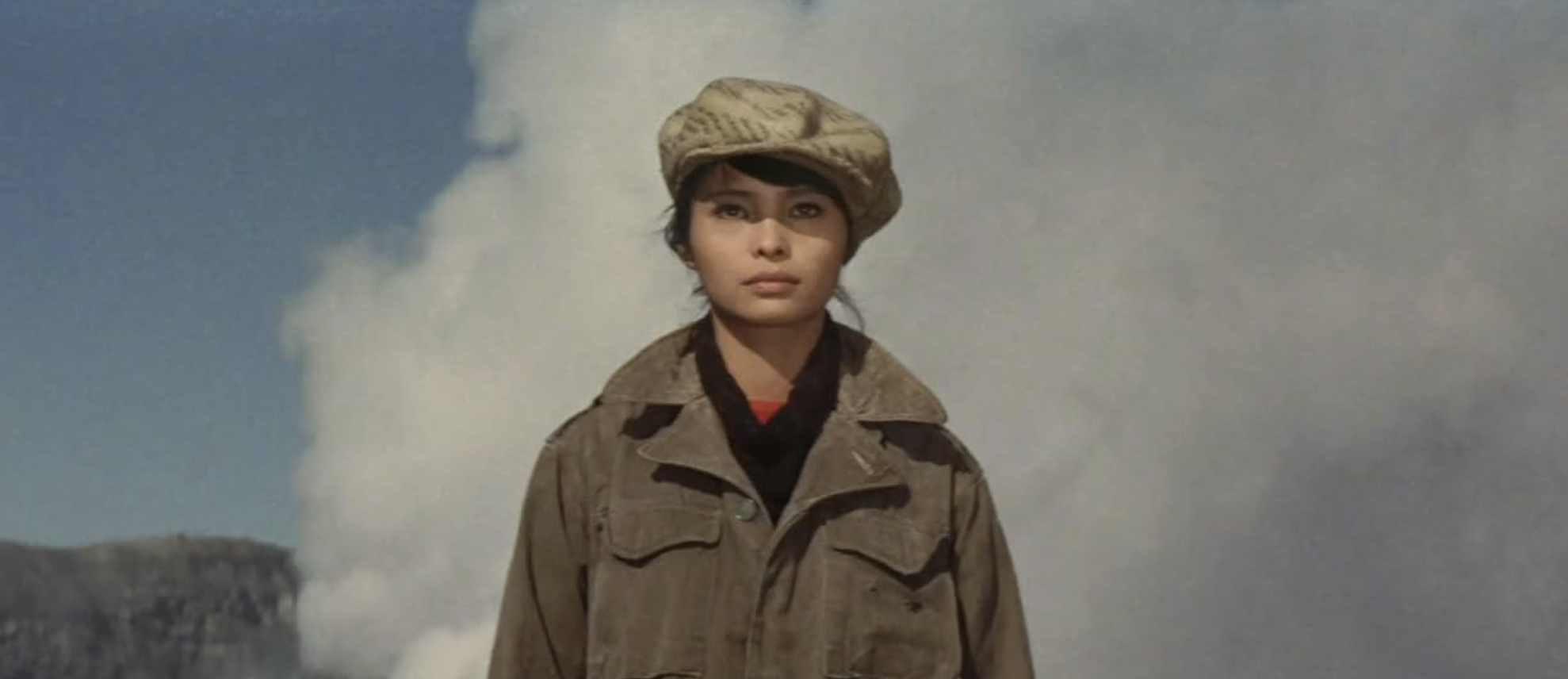
Princess Salno (L), The Venusian (R)
This is not necessarily a bad thing—it could even be leveraged for building more just and equitable futures, depending on the Venusian’s message (though we do acknowledge some glaring issues here in regards to consent and bodily autonomy).
Our best advice to those of you traveling by air: stay alert and pack plenty of snacks.
LESSON FOR HUMANITY No. 3: Believe Folks When They Share Their Experiences—Especially Regarding Oppression, Violence, and Apocalypse(s)
The Prophetess from Venus—who temporarily inhabits the body of Princess Salno of Selgina, pictured above—warns anyone within earshot of coming catastrophe. She correctly predicts Rodan’s emergence from the Aso Volcano and Ghidorah’s arrival.
To shed light on why defeating Ghidorah is so crucial, she explains: thousands of years ago, Ghidorah rendered Venus uninhabitable. She and other Venusians escaped a dying Venus by coming to Earth.
The people of Japan—predictably—ignore her, call her names, and forcibly sedate her to have her examined by a psychiatrist.
We see many parallels between the treatment of the Venusian and America’s treatment of Black, brown, Indigenous, queer, and disabled people.
State control of bodies, speech, and identity is not a new phenomena.3 Folks have been telling us about their worlds being blown to bits since before the United States was a country.
Below, we offer three examples of these experiences through the lenses of medical violence against Black people, the American Eugenics movement, and the continuous genocide of Indigenous peoples.
CONTENT NOTE: To folks impacted by state violence and descendents of impacted folks: you already know all of this, in your bones and in your hearts—skip this lesson. It is not for you. To folks who might feel uncomfortable but will not be re-traumatized by these facts: we implore you to read and breathe through your discomfort.
- Harriet Washington (Medical Apartheid: the Dark History of Medical Experimentation on Black Americans from Colonial Times to the Present) on medical violence against Black people throughout American history :
…race, culture, and economics have trumped medical and scientific truths at every turn … because the culture of American medicine has mirrored the larger culture that encompassed enslavement, segregation, and less dramatic forms of racial inequity. - Page 9, Medical Apartheid
Slaves were physically forced into painful medical bondage, their bodies were forced onto the stage of medical experiments to lend credence to claims of black inferiority and difference, and black bodies were even conscripted for anatomical dissection after death. Blacks were made subjects of experimentation that served to denigrate their intelligence or to provide distorted justifications for their enslavement. The reproductive rights of blacks also have been subjugated via fraudulent research up to the present day. Groups of vulnerable blacks, including children, soldiers and prisoners, have been consistently targeted. Both the federal government and private corporations have devised large-scale research abuses that range from radiation experiments to biological-weapons development. … it has mirrored the larger American cultural beliefs as well as politics and economic trends. - Page 385, Medical Apartheid
- Sarah Spriggs (Fearing the Black Body: The Racial Origins of Fatphobia) on Eugenics, antiblackness, and fatphobia in the 1880s United States:
…America was the land of the lofty race of lean Nordics or Aryans. [Eugenicists] devised theories to confirm Nordic/Aryan supremacy—and southern and eastern European degeneracy. They simultaneously worked to promote the judicious mating of the superior peoples.
While politicians crafted anti-immigrant legislation and scientists generated studies on (eugenic) racial inheritance, artists and journalists also had their part to play. In the popular press, the question of the racial-and relatedly physical-character of Americans loomed large.
In the spirit of American exceptionalism, they embraced the country as a melting pot of morally upright, democratic, and forward-thinking peoples. Yet they were clear to specify which nations, races, and peoples contributed to this arcadian melting pot: those from northern and western Europe. With women commonly being used to represent the nation, the emerging face and figure of American exceptionalism as seen in mainstream art and media was the trim Nordic woman. - Page 159, Fearing the Black Body
- Roxanne Dunbar-Ortiz (An Indigenous Peoples’ History of the United States) on the genocidal formation of the United States:
US history, as well as inherited Indigenous trauma, cannot be understood without dealing with the genocide that the United States committed against Indigenous peoples. From the colonial period through the founding of the United States and continuing in the twentieth century, this has entailed torture, terror, sexual abuse, massacres, systematic military occupations, removals of Indigenous peoples from their ancestral territories, and removals of Indigenous children to military-like boarding schools. The absence of even the slightest note of regret or tragedy in the annual celebration of the US independence betrays a deep disconnect in the consciousness of US Americans.
Settler colonialism is inherently genocidal in terms of the genocide convention. In the case of the British North American colonies and the United States, not only extermination and removal were practiced but also the disappearing of the prior existence of Indigenous peoples—and this continues to be perpetuated in local histories. - Page 9, An Indigenous Peoples’ History of the United States
We wonder what our present might look like if we had listened to and taken these stories seriously sometime in the last 400 years. We do not know, but we do hope that this information helps to inform a political grounding as we continue to imagine just and equitable futures.
LESSON FOR HUMANITY No. 4: Even Rivals Can Collaborate to Defeat an Existential Threat
In addition to being a film about the absurdity of borders and apocalypse, Ghidorah, the Three-Headed Monster is a film about the common phrase: “teamwork makes the dream work.4”
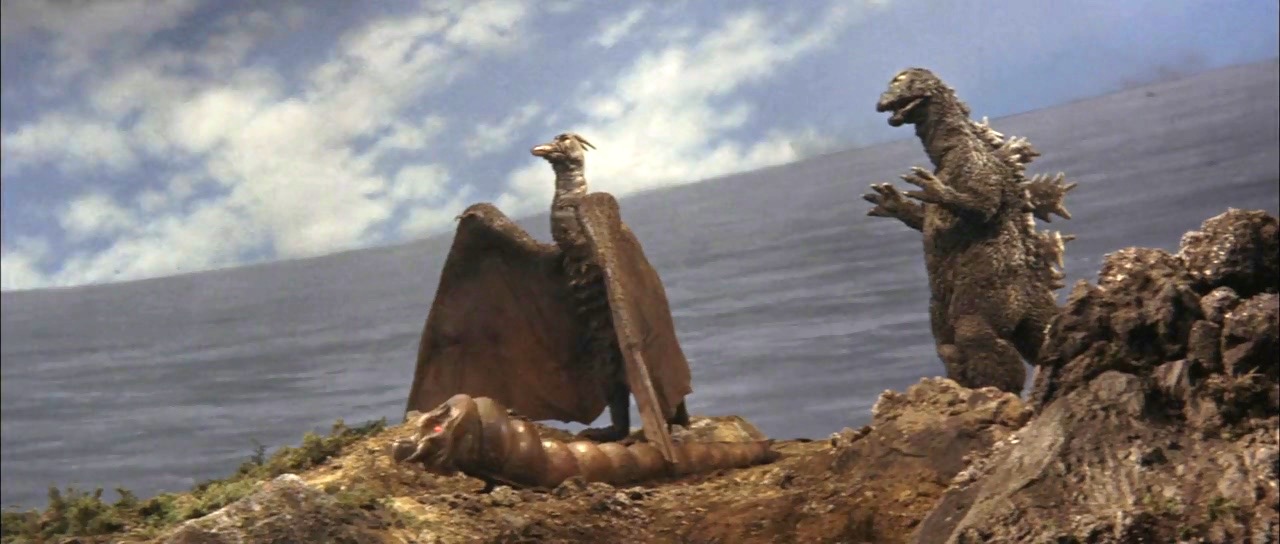
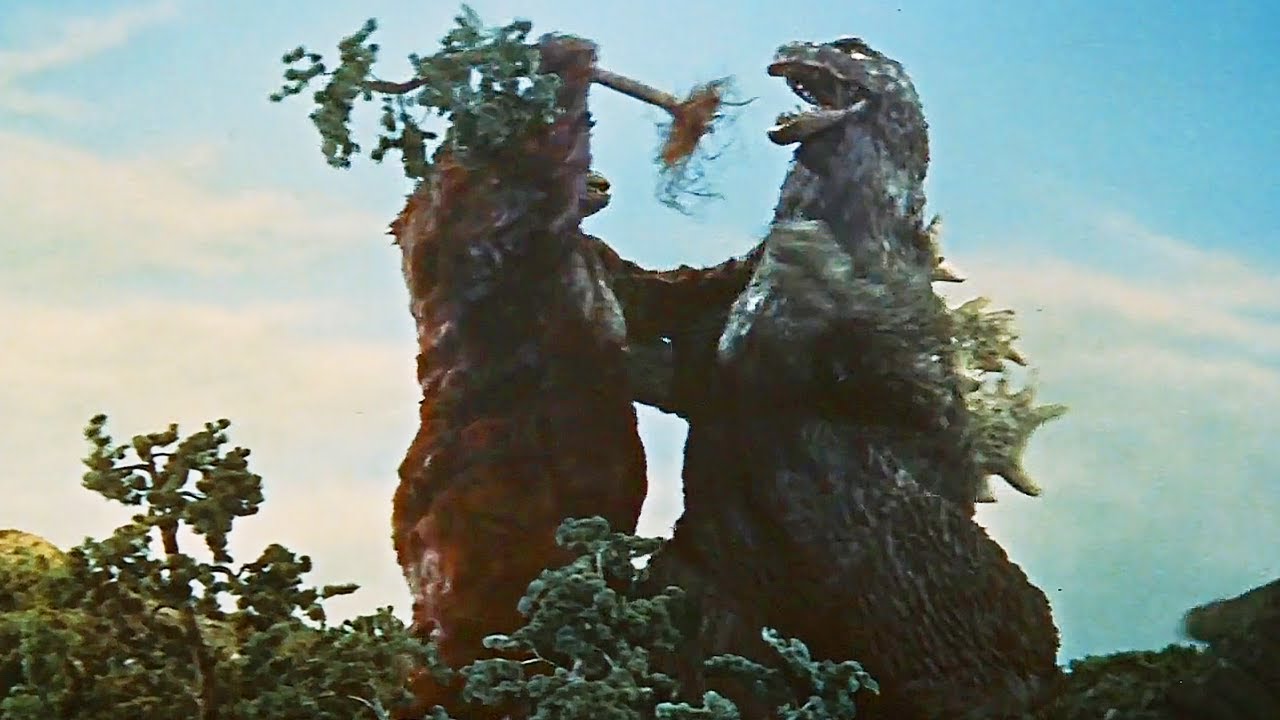
Though Godzilla, Rodan, and Mothra are usually enemies, they come together (only after Godzilla and Rodan gnash their teeth and ferociously volley rocks back-and-forth between their noggins).
Mothra takes on the emotional labor of diplomatic facilitation as she tries to convince Godzilla and Rodan to defend the Earth from Ghidorah. Ryfle and Godziszewski outline the epic fighting in Ghidorah, the Three-Headed Monster:
Rodan and Godzilla harbor a mutual grudge, stubbornly demanding an apology and refusing to budge. But when Mothra confronts King Ghidorah alone, the pair relent and join the fight. The Earth monsters prevail via clever teamwork, Godzilla holding King Ghidorah back while Mothra—assisted by Rodan—cocoons the dragon in sticky silk. - Page 89, The First 70 Years
None of this suggests that Godzilla and Rodan are (as members of the public might say) “buds”. Regardless, they were able to set aside their conflict-of-the-day to beat Ghidorah’s ass; something none of the Earth Kaiju could have done alone.
This is not an argument for blanket forgiveness of those who have caused us harm—this is an example of the episodic collaboration that is sometimes necessary to defeat existential threats, such as technofascism.
We do hope that after the kerfuffle, Godzilla and Rodan were able to navigate the conflict between them in a productive and kind way. We are grateful to the Kaiju for understanding the interdependent nature of our lives and world(s) amd acting accordingly.
To underline the importance of collective action such as this, we offer a quote from in It’s Not That Radical: Climate Action to Transform our World:
[Collectivism] requires us to change how we live our lives, as we are aware that the way we live is because of the way others live, and therefore how we choose to act impacts the way others are able to live. To lean into collectivism, to see the similarities in our still-unique experiences, is to find our way out of this. It’s to know that none of us are truly free until all of us are free. - Page 206, It’s Not That Radical
LESSON FOR HUMANITY No. 5: The Earth Does Not Belong to Humans Alone
During her effort to convince Godzilla and Rodan to help defend the Earth against Ghidorah, Mothra pleads:
“The Earth doesn’t belong to humans alone. It’s ours too, and we should defend it.” - Mothra
The Earth does not belong to humans alone. What might our shared futures look and feel like if we took collective responsibility for our home, not just in collaboration with other humans but also with our more-than-human neighbors?
For too long, some of humanity has acted as though the Earth is ours to use and abuse as we please. As we noted in Field Report No. 5, exploitation of other living beings is more possible when humans consider themselves as separate from nature instead of a part of (and interdependent with) nature.
In closing, we once again offer Mikaela Loach’s wisdom regarding what it will take to build just and equitable futures, in the context of climate action:
This fight cannot only be worth it if we are guaranteed to completely win the new world within our lifetimes. Make no mistake, what we are fighting for is huge. It’s unlikely to be won completely within my lifetime. We might not even be able to see the changes happening around us. That does not mean we give up. That does not mean the fight is not worth it. There is so much we won’t see. There is so much we haven’t seen. For so many of us, the degree to which we are liberated is the result of so many actions - big and small - of those who came before us. I am so glad that they thought acting to change the world was worth it. I might not be here if they hadn’t. - Page 224, It’s Not That Radical
The Kaiju, who are much older than us, know this. It is time we catch up. For more thoughts on not giving up, see Lesson for Humanity No. 4 in Field Report No. 5: Be More Stubborn. Be Blatant. Be Emotional. Risk Everything.
Rations are well-stocked once again. Thank you for sending fun snacks. We hope these were not a bribe to prevent us from striking.
Yours in Science7,
The Godzilla Field Office
/ / / END OF TRANSMISSION
As long as they don’t start telling us what to do. ↩
It is important to acknowledge that the majority of the team (except for Egg, Director Stevens, and Chief Of Mission Cramblin) are descended from colonizers, conquerors, and enslavers. We acknowledge that this is a messy business, and work everyday to practice accountability, further our political education, and to act in transformative solidarity with descendents of those our ancestors harmed. ↩
Though some of us act like it because now the phenomena of violent state control is impacting a higher number of White Americans. ↩
Recently proven in another universe where the Field Office Team worked in collaboration with (!) ↩
This made all of us laugh very hard. ↩
This made all of us cry. ↩
This mission is dedicated to the memory of Harvey Rowe. ↩