GODZILLA FIELD REPORT No. 6
Five lessons for humanity regarding the lineage of ideas, collaboration, silliness, open knowledge, and avoiding trains when fleeing a Big Monster
New to the Mission? Start Here: Mission Kaiju_Love_Care_Futures_02026 Site Index
INCOMING TRANSMISSION / / /
We hope that your decision to introduce the team to the public is helping to build trust with the public. We would also thank you for refraining from redacting Lesson For Humanity No. 5 (eggs) in our latest field report.
We apologize for sending our Field Reports about Mothra vs. Godzilla (1964) and King Kong vs. Godzilla (1963) out of chronological order. It took us a while to dig up a copy of King Kong vs. Godzilla, and even then, it is the American re-edit of the original Japanese film from 1962. We urge Mission HQ to please allow us the resources to obtain access to Criterion’s Godzilla: The Showa Era Films, 1954 -1975. It retails for $179.96. We have done the math, and if:
22 people become monthly paid subscribers, OR
One person becomes a Mission Patron (aka Founding Subscriber), OR
Folks use this link to make a one-time monetary donation (not tax deductible)
…we will be able to access the proper, original King Kong vs. Godzilla (1962). Please remind supporters that paid subscribers receive Godzilla-themed postcards from us each month, and Mission Patrons will receive (in addition to postcards) a photograph of a plaque with their name on it installed here at the Field Office.
Based on how egregious the American re-edit of Godzilla (1954) was (see our analysis here), we believe that our research will be badly flawed without the inclusion of the original 1962 version. Our hypotheses are that the 1962 version offers explicit lessons about corporate greed and that a comparison of the two films might offer insights into narrative power and neo-colonialism.
That said, we continue to be good boys, and below we offer lessons from the American version of King Kong vs. Godzilla (1963). If this information drought continues, we may cease to be good boys and will organize a strike.
GODZILLA FIELD REPORT No. 6
Date: April 2, 020261
Location: Brooklyn
Mission: Kaiju_Love_Care_Futures_02026
Artifacts Examined:
King Kong vs. Godzilla (1963 - The U.S. Version)
Pages 54 - 67: King Kong vs. Godzilla, Chapter One of Part One: Beast of Burden: 1954 to 1975 of Ryfle, S., Godziszewski, E., Carpenter, J., Odaka, M., & Tomiyama, S. (2025). Godzilla: The First 70 Years: The Official Illustrated History of the Japanese Productions. Abrams Books.
Pages 30 - 35: Godzilla: King of the Monsters! (1956), of Skipper, Graham. (2022). Godzilla: The Official Guide to the King of the Monsters. Welbeck Publishing.
Rations Consumed: four espressos, one bag of popcorn, a banana, several handfuls of wasabi peas, at least one bad attitude
Chief of Mission (AKA Dudley the Dog) Present? Yes
Please find below five lessons for humanity that might help us build more just and equitable futures.
LESSON FOR HUMANITY No. 1: Honor the lineage of your work
All of us are building on work by those who came before us, all of the time. As Mindy Seu writes in Cyberfeminism Index:
“I think that the greatest feminist technology has always been the practice of citation, because it shows that everything, in some way, is co-authored, that it was never about the individual hero. Always a collective or community.”
Ryfle and Godziszewski highlight this practice as they take us behind-the-scenes to the making of King Kong vs. Godzilla (1963):
“[Screenwriter Shinichi Sekizawa] later recalled the excitement surrounding the production. “I remember thinking, I might get to write about that guy who climbed the Empire State Building,” he said. Though the tone is far removed from the original King Kong, Sekizawa included homages to it, such as the wooden ramparts on Faro Island that protect the natives from their monster-god and Kong beating his chest. “Instead of goofing around and trying to come up with something new, I thought it would be better to keep what’s already there. Those things were a must,” he said. - Page 58, The First 70 Years
We at the Field Office believe that this practice of co-authorship—of honoring what came before and of creating as a collective—will help humanity divest from violent ideas of rugged individualism and scarcity.
We should note here that our fellow scholar recently wrote about co-authorship with our more than human world, including oysters, a harbor, and water itself. Read more here:

None of us knows everything, together we know a lot.
LESSON FOR HUMANITY No. 2: Effective collaboration and coordination are skills that take time and practice to develop
As Eugene Kim teaches us, collaboration requires a set of muscles, and we strengthen these muscles by exercising them repeatedly.2 These muscles take time to condition! Effective collaboration requires trust, which does not develop overnight.
The memorable Godzilla-versus-train sequence is a fine example of the coordination between the Honda (Director) and Tsuburaya (Special Effects) teams, shooting the live-action drama—in this case, on location at Gotemba, near Mount Fuji—and special effects footage on a Toho stage. By now the two directors had an established system involving advance planning and storyboarding, constant communication via assistant directors, and one-on-one meetings. Colleagues said the men developed an unusually close understanding in which words were not required. “They could almost read each other’s minds,” remembered Haruo Nakajima.
When I went to Stage No. 9 every morning at 9 A.M., they were already there, discussing the connections between the drama and effects parts. ... Mr. Honda goes, ‘How do you want to handle this part?’ and Oyaji-san answers, I think it’ll work out like this! They understood one another just by saying this part’ and ‘that part. I had no idea what they were talking about.” - Page 58, The First 70 Years
While it may seem obvious to some, we would like to point out that collaboration and coordination are distinct-yet-related practices.
In this case, coordination looks like information sharing and managing logistics (“constant communication via assistant directors”) and collaboration looks like discussing and brainstorming (“How do you want to handle this part?”). Different moments require different levels of working together.
An assumption implicit in this lesson that we would like to make explicit: We take “By now … “ to suggest that this level of coordination and collaboration between Honda and Tsubaraya took time and practice, and that they likely stepped on each other’s toes a few times before developing their ways of working.
We believe that humanity would do well to remember that these kinds of relationships take time, space, and some level of willingness to engage in conflict navigation and repair. It follows, then, that humanity would do well to unlearn disposability politics and cancel culture3, but we digress.
LESSON FOR HUMANITY No. 3: Fierce and silly are not mutually exclusive
Our culture has a tendency to engage in either-or, binary thinking. We appreciate Toho’s work, as it shows us that “fierce and silly” can—and often do—exist on the same plane:
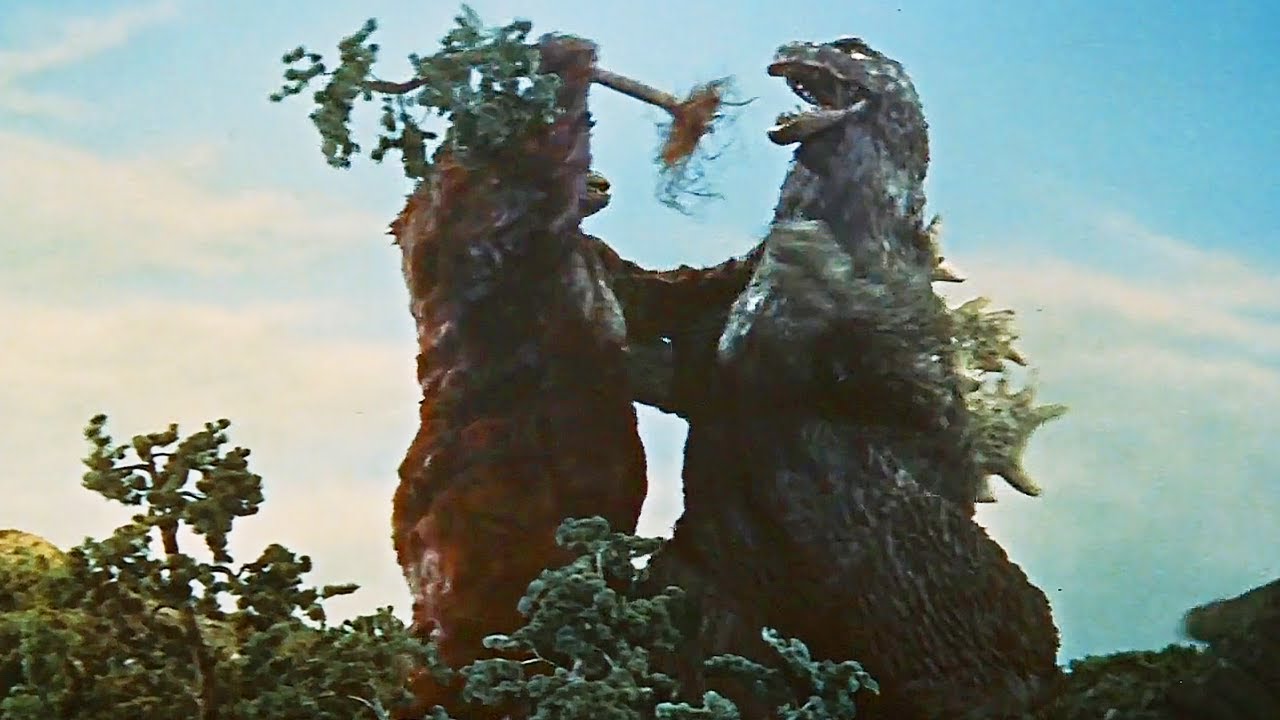
The final showdown is the first Toho monster battle to take place, significantly, beneath Mount Fuji, the tallest mountain in Japan and the nation’s sacred symbol, surrounded by temples and shrines. In this revered spot, the monsters engage in a battle alternately fierce and silly. - Page 62, The First 70 Years
Just because something is “silly” does not mean it is not also formidable. Humanity would do well to remember this, especially when deciding who and what to take seriously.
LESSON FOR HUMANITY No. 4: Open knowledge = open hearts and minds
Knowledge hoarding is a key component to capitalism and keeping the masses divided. Just as the lies behind racism and eugenics are tools to keep the working classes divided (lest they unite against the much smaller ruling class), so too is Universal Production’s treatment of King Kong vs. Godzilla’s copyright.
While conducting our artifact review, we read:
It should be noted that this chapter covers the original, Japanese-language version of King Kong vs. Godzilla, which first became available in the US in 2019 through the Criterion Collection. For the preceding fifty-six years, the film was seen in America and certain Western territories only in a drastically altered version produced by John Beck and released theatrically in 1963 by Universal-International. Scenes were deleted and reordered, Ifukube’s music was largely replaced with library cues, and Honda’s TV satire was obfuscated by frequent inserts of actors portraying newscasters. This cut is largely responsible for the criticism the film has received outside Japan. The existence of different versions across the globe also led to a legendary rumor that each edit had a different ending, with Kong winning the fight in America and Godzilla in Japan. In truth, both versions end the same way: ambiguously, with Kong swimming 3,000 miles (4,828 km) back to Faro Island and Godzilla disappearing below the depths. - Page 66, The First 70 Years
And:
Of course, the US crafted its own dubbed version of the film, re-editing much of the movie and filming entirely new segments, just as it had done with Godzilla in 1954. In the American version, several newscasters comment on the events from afar, while Mr. Tako is almost entirely cut out of the movie, as it was feared his cartoonish performance would be deemed too silly by American audiences. - Page 33, The Official Guide
We previously covered the American-led whitewashing and dilution of Godzilla (1954) through the analysis of Godzilla: King of the Monsters! (1956)
 The Godzilla Papers
We are just as frustrated now as we were then.
Please refer to our request for resources/threat to strike in the introduction of this document.
LESSON FOR HUMANITY No. 5: Getting on a train in a monster movie is a bad idea
Each time we see a movie monster and a train, it ends badly for both the train and the passengers.
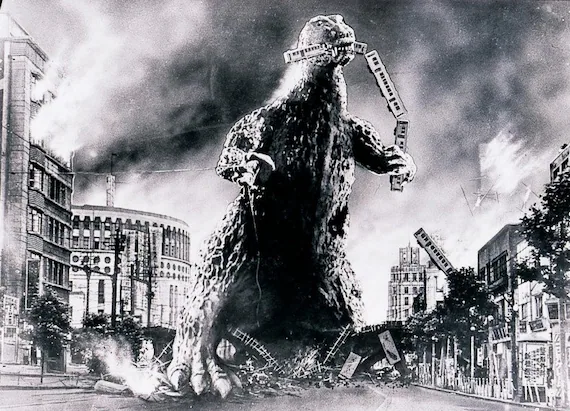
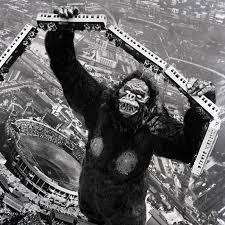
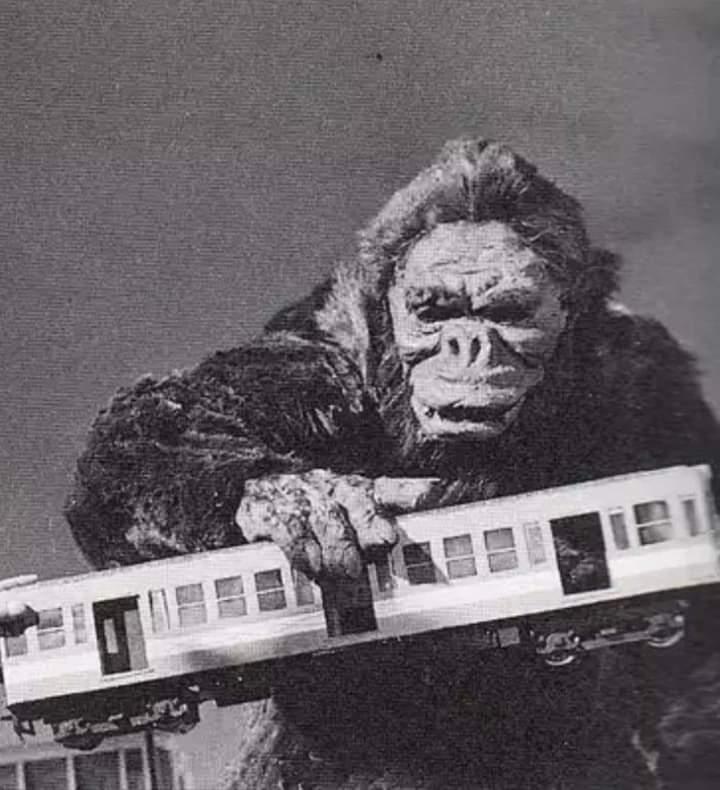
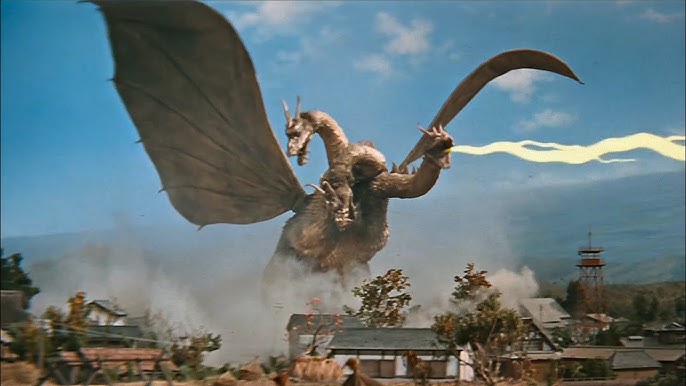
Godzilla munching on a train in 1954, King Kong picking up a train in 1962/3.
If one finds oneself in the vicinity of Godzilla, Kong, or other Kaiju, we suggest one considers the train as one’s last resort.
Rations are (mostly) well-stocked, though we could use more fun treats.
Please send money.
Yours in Science4,
The Godzilla Field Office
/ / / END OF TRANSMISSION
The mission team learned this “Long Now” formatting—whihc suggests we are in a 10,000 year cycle instead of a 1,000 year cycle—from the author and artist behind the publication called Seed & Signal™. Mission supporters are encouraged to subscribe. ↩
Joining Eugene’s Collaboration Gym is an excellent way to exercise one’s collaboration muscles. If you join, you might catch a glimpse of members of the Field Office Team. ↩
adrienne maree brown’s We Will Not Cancel Us is a helpful resource for this. ↩
This mission is dedicated to the memory of Harvey Rowe. ↩