GODZILLA FIELD REPORT No. 4
Three lessons for humanity regarding narrative power, the myth of apolitical decisions, and the risks of relying on one source of information.
New to the Mission? Start Here: Mission Kaiju_Love_Care_Futures_02026 Site Index
INCOMING TRANSMISSION / / /
We at the Field Office are grateful that Director Stevens approved our proposed scope revision. We agree that this change will allow members of the public to engage with our work more meaningfully. From this moment on, we will frame our reports to offer lessons that might support humanity to co-build more just and equitable futures.
We also received your directive to stop making things up. We will try to comply.1 That said, we would like to note that—as those of us who were involved recall—the Whistling Bears mission of 2016 was a wild success.
While we do not want to seem ungrateful, we must share that we are—to use the colloquial term—“bamboozled” by you and Dir. Stevens’ decision to establish a mission Arts Department without our input.
We can sense from your directive that you are not keen on the lesson we offered in our last transmission (trust the people closest to the work), but we were still dismayed to learn the details about this new Arts Department alongside the public in the latest Press Release. We will, as you suggest, “cooperate” with those in the Arts Department, but we would like our dissatisfaction noted in the official Dissatisfaction Ledger.
In other news, we have completed our revision of the Research Methodology. We hope you find the changes satisfactory. You will see that we went to great lengths to ensure that the newly formed2 Arts Department is represented, because—as we feel the need to remind you—we are good boys.
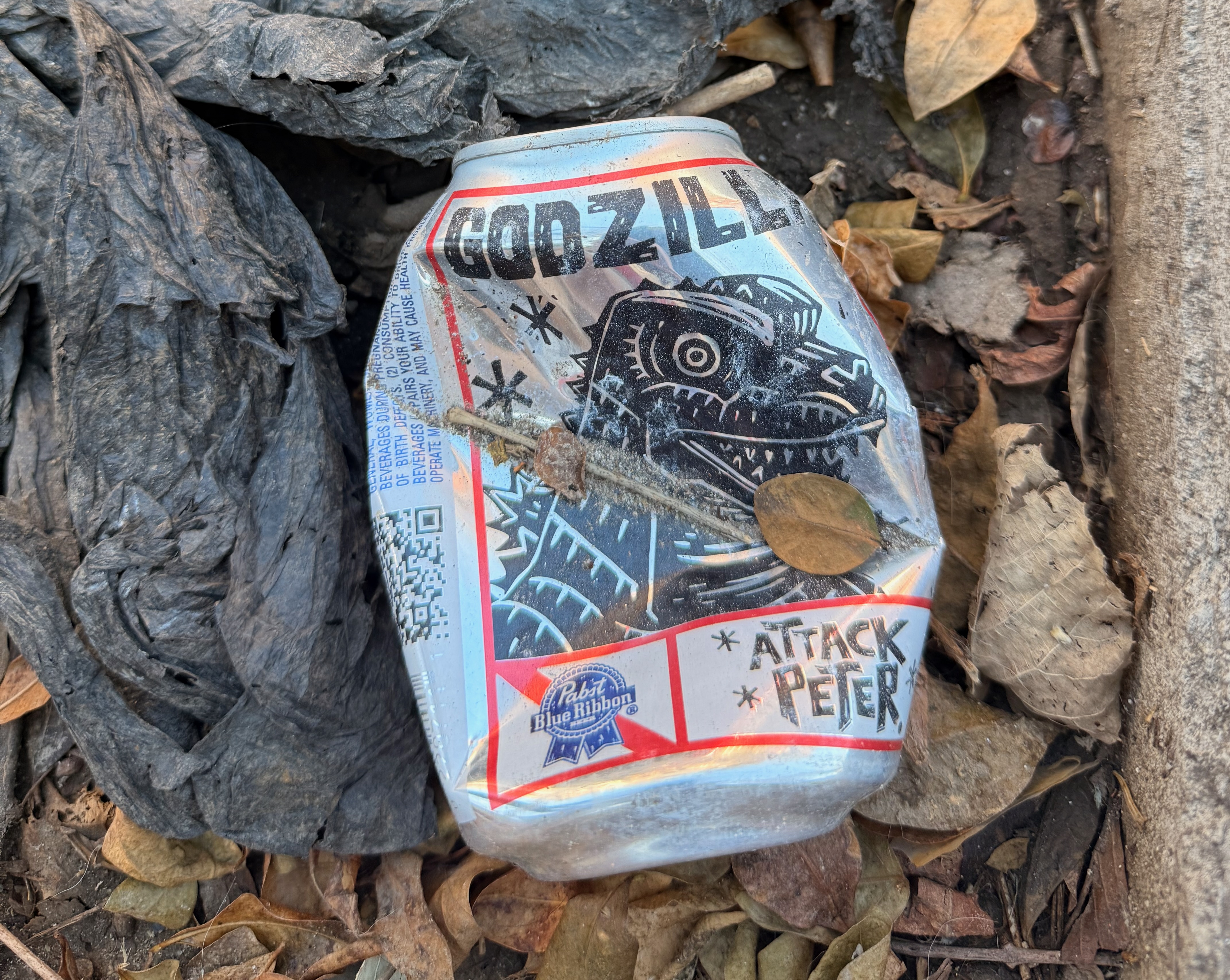
Finally, as you suggested, we brought one of our cellular-device-embedded-cameras on the Chief of Mission’s morning walk. Luckily, the artifact we mentioned in Field Report No. 3 remained in place.

The question emerging for the Chief of Mission here is: "What is the mentality that allows a consumer to leave an artifact featuring a symbol of climate justice and environmental protection on the ground?"
What follows is a Field Report reflecting on the lessons offered in Godzilla: King of the Monsters! (1956), the American re-edit of Godzilla (1954).
You might detect a contemptuous tone throughout this Report. Suffice to say: we hated this. We acknowledge that we perhaps are viewing this artifact through a different lens than American moviegoers in 1956, and we do not wish to detract from any fondness they may have for the film.3 It was, after all, the only version of the original Godzilla available to the American public until 2004.
GODZILLA FIELD REPORT No. 4
Date: March 19, 02026
Location: Brooklyn
Mission: Kaiju_Love_Care_Futures_02026
Artifacts Examined:
Godzilla: King of the Monsters! (1956)
Pages 36 - 37: Lost in America, Lost in Japan: Godzilla: King of the Monsters! (1956), Chapter One of Part One: Beast of Burden: 1954 to 1975 of Ryfle, S., Godziszewski, E., Carpenter, J., Odaka, M., & Tomiyama, S. (2025). Godzilla: The First 70 Years: The Official Illustrated History of the Japanese Productions. Abrams Books.
Page 15: Godzilla: King of the Monsters! (1956), of Skipper, Graham. (2022). Godzilla: The Official Guide to the King of the Monsters. Welbeck Publishing.
Rations Consumed: three espressos, red beans and rice, tinned fish, a banana
Artifact Review Soundtrack: Hurray for the Riff Raff’s The Navigator
Chief of Mission (AKA Dudley the Dog) Present? Yes
You might consider this Field Report a deeper exploration of Theme 5 of Field Report No. 2: Everything is Political. We argue that this film is a study in narrative power, the myth of apolitical decisions, and the risks of relying on one source of information.
Stories—and how they are told—hold immense power to shape culture and policy. We should treat them (and the people from whom they come) with care and reverence.
LESSON FOR HUMANITY No. 1:
We should not edit others stories, especially when we are the ones responsible for harm.
The American studio took an axe to the orginal Godzilla. They edited footage, changed lines, chopped up the timeline, and added new storylines to remove almost any reference to immense harm caused to Japan and its people by the U.S. Empire.
We believe this is a particular form of narrative violence. Some of the most egregious changes include:
Rather than let the story flow, as it does in the original, the American version is narrated by an American journalist who is “just stopping over in Japan,” rendering the origin of the story an afterthought. This journalist also somehow makes his way into important rooms where top secret missions are discussed. We don’t buy it.
The American version removes any mention of the U.S.’s bombing of Hiroshima and Nagasaki. We counted one (1) mention of the H-bomb test at Castle Bravo by Dr. Yamane, and the edits treat this as an unimportant piece of information.
The American version removes any mention of radiation. When the team investigating the happenings on Odo Island are standing in Godzilla’s footprint, they only go as far to use the word “contamination.” In the original Godzilla, this is called what is it: radiation. To illustrate the general feeling here at the Field Office: some of us yelled at the television during the scene in which Dr. Yamane picks up a trilobite and his colleagues urge him not to touch it with his bare hands: “Are you gonna say WHY Dr. Yamane shouldn’t pick up that trilobite? ARE YOU GONNA SAY WHYYYYYYYY?!”4
In the original Godzilla, Odo Islanders speak to journalists and then come to Tokyo to testify about their tragic and terrifying experience with the massive monster. In 1954, English subtitles tell us that this group of people are “petitioners.” In the American re-edit, they are “interrogated by authorities” and referred to as “Islanders … brought by officials for a direct report.” We are sure we don’t need to tell you—this edit shifts the power dynamics, robs Odo residents of agency, and takes a decidedly authoritarian approach to how people within the story tell their stories.5
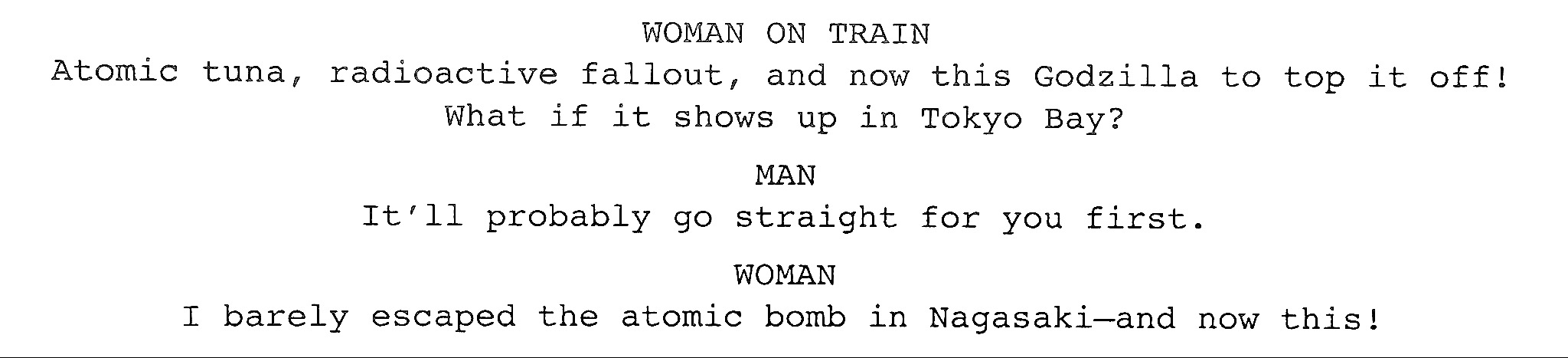
The American version removes what we believe is a crucial scene that helps us understand cultural and historical context for Godzilla. In this scene, commuters on a train (which minutes later is crushed by Godzilla in the same style of the Chief of Mission when he chews on his stuffed platypus6) converse:
- We argued in Field Report No. 1 that Godzilla (1954) is, among other things, a film about how being a radio broadcaster is a Very Dangerous job. In the American re-edit, we only see the radio broadcasters once, which rids the film of this crucial lesson.
We would like to argue that this was not a simple re-edit of the original Godzilla movie, but an act of colonization, erasure, and revisionist history. Those of you at Mission HQ might find this—as you’ve called our analysis in the past—”extreme.” Respectfully, you are wrong.
To be clear: we are aware of Japan’s Imperial history, and do not wish to appear to romanticize Japan or any other nation-state. We focus on the United States of America because:
- This is an American film.
- We at the Field Office are most familiar with American history.
LESSON FOR HUMANITY No. 2:
Everything is political, nothing is neutral. We should act accordingly.
Some of the most political decisions are often defended as “apolitical.” We argue that there is no such thing.
Let us repeat a note from Field Report No. 2.
Ryfle and Godziszewski give us an overview of how this abomination was made after an American studio bought the rights:
“More than one-third of the original film was excised; scenes were shortened or deleted altogether, including key references to the atomic bombing of Japan, Godzilla’s relationship to hydrogen bomb testing, and political squabbles over whether to make this information public. Notably, Dr. Yamane’s final speech about the dangers of nuclear testing and the likelihood of another Godzilla was removed, and the American cut ends with Burr instead declaring that “the whole world could wake up and live again.”
Because the film arrived in theaters at a time when the US and USSR conducted hundreds of hydrogen bomb tests, these changes to the film have fueled speculation that the American distributors neutered the antinuclear message for political reasons. “No,” responded producer Richard Kay. “We weren’t interested in politics, believe me. We only wanted to make a movie we could sell.” Kay noted that the film was released just eleven years after World War II. “At that time, the American public wouldn’t have gone for a movie with an all-Japanese cast. That’s why we did what we did. We didn’t really change the story. We just gave it an American point of view.”
Nothing is neutral. By this we mean: the way we walk down the street, the way we work, and the way we tell (or don’t tell) stories reflects a set of values. The actions we take or don’t take reinforce beliefs, structures, and ideologies. Systems are made up of people, after all.
This is not to say that every person should be stressed out, hypervigilant, and over-careful at all times—this is to invite us to remember that we each have an impact on the world around us.
LESSON FOR HUMANITY No. 3:
When we get all of our information or education from one source, our understanding of the world is not our own.
If one has only seen King of the Monsters, one might think that the original Godzilla is simply a silly monster movie7 rather than the tender, artful, educational treasure that it is.
We wonder, actually, if this will be an obstacle in recruiting participants for our sensemaking sessions—if Americans’ understanding of the franchise is colored by King of the Monsters, we have much work ahead of us. In fact, some of us have run into puzzled looks while distributing informational flyers in the field. People unfamiliar with the depth of the Godzilla franchise ask: “What could a bad monster movie teach us about love?” What, indeed.
Rest assured, we act in accordance with one of the core principles of Good Public Engagement: we do not make a face. We lead with curiosity and ask them to say more about why they use the word “bad.” Some reciprocate with their own curiosity, some do not. That is the way the cookie crumbles, or so we have heard.
Consider: What might have happened if the original film was shown in American theatres? If not in the mid-1950s, sometime before 2004? Where might we be if everyone had agency over how their stories are told?
We suppose that these are questions for the Arts Department.
Morale is “fine.” We look forward to returning to the Japanese productions—our next Field Report will investigate the lessons offered in King Kong vs. Godzilla (1963). As you know, we can only access the American version of the film. For reasons outlined above, we would like to request—again—that we be allowed the resources to access the Japanese cut of the film, released in 1962. As far as we can tell, the only way to access this is by purchasing Criterion’s collection, called Godzilla: The Showa Era Films, 1954 - 1975. We have read that the Japanese version of King Kong vs Godzilla (1962) is to be found on a Bonus Features disc. We would send a request form, but you told us not to.
Yours in Science,8
The Godzilla Field Office
POSTSCRIPT: SABOTAGE TRACKER
Still quiet for the most part, though we keep finding post-it notes with the words “Kong is King” around the Field Office. We do not know if this is the work of the man who also lives at the Field Office or the work of a competing Mission. Will send updates as we have them.
/ / / END OF TRANSMISSION
wink wink ↩
(Without our input) ↩
We are thinking specifically about John Carpenter’s foreword to Godzilla: The First 70 Years, in which he pens a touching recollection of his viewing of Godzilla: King of the Monsters! in 1956. ↩
Yelled in the style of I Think You Should Leave’s Tim Robinson yelling, “YOU SURE ABOUT THAT THAT’S WHY?!” in the Carber Vac sketch. ↩
Meta story theft. ↩
Unlike Godzilla, the Chief of Mission doesn’t cause nearly as much damage. He has a much smaller body than the King of the Monsters. ↩
We would like to reassure the public that silly monster movies have their place—we love silly monster movies. What King of the Monsters did was not silly, but morally wrong. ↩
This mission is dedicated to the memory of Harvey Rowe. ↩