GODZILLA FIELD REPORT No. 9
Five lessons for humanity from Ebirah, Horror of the Deep about the power of dance in our fight against fascism, unlearning anti-Indigenous racism, the importance of naps, the benefits of a hacky sack routine, and the fact that fascist regimes will destroy everything before accepting defeat.
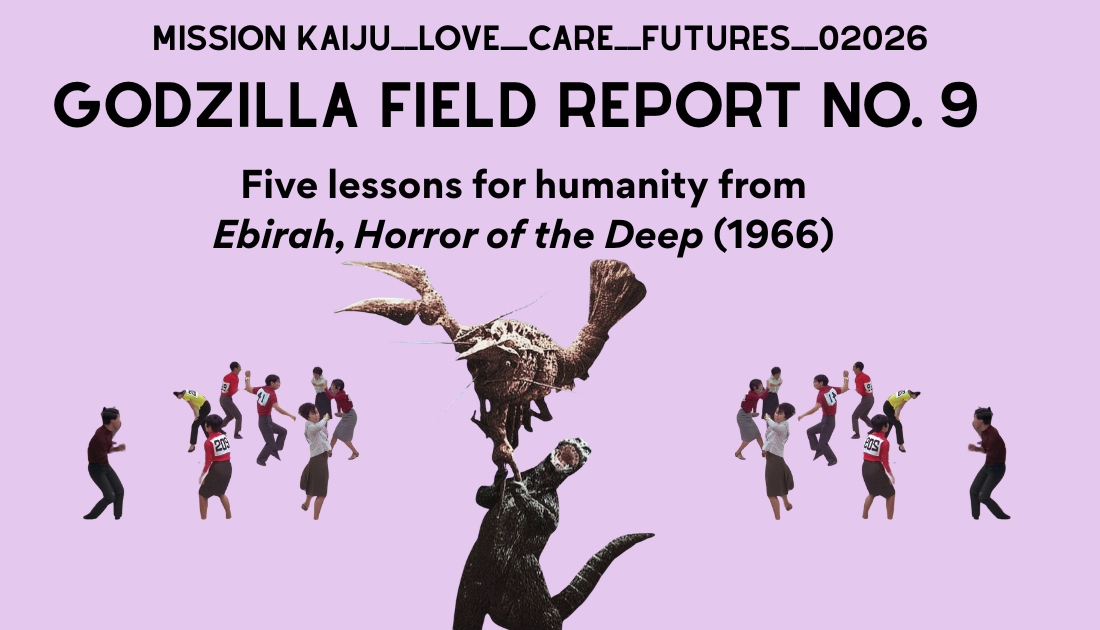
Five lessons for humanity from Ebirah, Horror of the Deep (1966) about the power of dance in our fight against fascism, unlearning anti-Indigenous racism, the importance of naps, the benefits of a strict hacky sack routine, and the fact that fascist regimes will destroy everything they can before accepting defeat.
New to the mission? Access the site index here!
INCOMING TRANSMISSION / / /
Hello,
We are settling back in from the Chicago trip and glad the Egg fiasco is over. It is concerning indeed that four members of the public unsubscribed after you shared the Eggcountability Statement. We thought the people wanted transparency! We do hope this Field Report can serve to rebuild trust with the public. Speaking of trust, we hope you are satisfied with Dr. Tex Collins' recent Methods Lineage Report. As we have stated on many occasions, this is real (fake) research and deserves to be taken seriously.
Dr. Tex Collins is looking forward to representing the mission at Kaiju Brooklyn on May 30 before he and Egg head up to Boston for some field work. Godzilla scholars in the Boston area are encouraged to get in touch via email (thegodzillapapers@gmail.com).
This Field Report is dedicated to the memory of a dear colleague of our Chief of Mission Mr. Dudley Cramblin, Townes “Tinto” Van Zandt “Pinto Bean” Pollett. Tinto was the Chief of Mission for Dr. Mr. Josaleigh “Tom Valley” Pollett. Tinto taught us about enduring love, patience, accountability, and the importance of doing big dives in a big bed. Dr. Pollett's work explores all types of love, friendship, collaboration across vast distances, and the intersection of electronic music and time travel. Tinto supervised the production of the upcoming album, If I Let it Quiet. We urge our supporters to pre-order the mission’s album on bandcamp and support the If I Let it Quiet tour of the Western United States (7/25/02026 - 8/14/02026).
GODZILLA FIELD REPORT No. 9
- Date: May 08, 02026
- Location: Brooklyn, NY
- Mission: Kaiju_Love_Care_Futures_02026
- Artifacts Examined:
- Ebirah, Horror of the Deep (1966)
- Pages 110 - 119: Ebirah, Horror of the Deep, Chapter One of Part One: Beast of Burden: 1954 to 1975 of Ryfle, S., Godziszewski, E., Carpenter, J., Odaka, M., & Tomiyama, S. (2025). Godzilla: The First 70 Years: The Official Illustrated History of the Japanese Productions. Abrams Books.
- Rations Consumed: two espresso, one chickpea crust pizza, three pieces of dark chocolate
- Chief of Mission (AKA Dudley the Dog) Present? Yes
We at the Field Office greatly enjoyed this artifact. The pairing of surf rock with Kaiju fights elicited several guffaws from the team. For those who have not engaged with this artifact, Ryfle and Godziszewski provide a succinct synopsis:
… Takarada plays a fugitive safecracker unwittingly swept up in a South Pacific adventure to rescue a young fisherman who has disappeared in a typhoon. In a far-fetched and amusing Robinson Crusoe-like tale, the crook and a trio of teenagers set sail on a stolen yacht, are shipwrecked by the gigantic crustacean Ebirah, and wash up on a remote island. The heroes are hunted by the Red Bamboo, and one boy is enslaved alongside natives kidnapped from Infant Island. As a diversionary tactic, the protagonists awaken Godzilla, and the sleep-deprived monster faces off with the big shrimp, a giant condor, fighter jets, and Mothra as she swoops in to rescue her people. Sensing a threat, Godzilla demolishes the terrorists' base, triggering the nail-biter of a final act. The heroes escape and, in a memorable endnote, the thankful humans beckon Godzilla to leap into the sea just before the island goes kaboom. - Page 112, The First 70 Years
…big shrimp, indeed!
What follow are five lessons for humanity from Ebirah, Horror of the Deep (1966) about the power of dance in our fight against fascism, unlearning anti-Indigenous racism, the importance of naps, the benefits of a strict hacky sack routine, and the fact that fascist regimes will destroy everything they can before accepting defeat.
LESSON FOR HUMANITY No. 1: Dancing against fascism is good for health. Dancing for capitalism will do us no good. (or, you can just steal a yacht)
In the beginning of the film, we see young people dancing fervently—pushing their bodies to the limit for the chance to win a yacht. When we see these exhausted young folks, they've been dancing for three days. Two young men (who turn out to be some of our protagonists) collapse and drag themselves to the sidelines to recover. Through a series of right-place-right-time happenings, the young men learn that they don't have to abuse their bodies for the chance at a yacht—they can just steal one! Much easier.
This contest is an excellent example of the many ways capitalism has co-opted natural human activities. People have been dancing for as long as they’ve had bodies! Case in point: later in the film, we see Infant Islanders dance and sing to wake Mothra so she will save their enslaved kin. This dancing is rooted in care, love, and self-determination.
This lesson is further reinforced by an Exhibition the team saw during a visit to the Museum of Contemporary Art Chicago, called Dancing the Revolution: From Dancehall to Reggaetón. We encourage our Chicago-based colleagues to visit and to dance, as Tex did.
Dance for your people, for Mothra, for health. Don’t let capitalism and scarcity dictate when and how you dance.
LESSON FOR HUMANITY No. 2: We must unlearn our anti-Indigenous racism.
Once our protagonists arrive on an island on their yacht-that-was-not-gained-through-dancing-for-capitalism, they begin looking for one of the young men’s brothers who was lost at sea. For those of you who like context: this is the whole reason they stole the yacht in the first place.
While exploring, they find a machete lying on the ground. They lean into one of the oldest racist tropes in the book of racist tropes: “Cannibals!”
…
Characterizing Indigenous and other colonized peoples as uncivilized cannibals is a trope used in many imperial playbooks, and several action movies have done their part to keep it alive. This tired story serves to dehumanize and mythologize people‚ reinforcing violent supremacist ideologies.
The machete was left behind by the Indigenous folks of Infant Island. The Infant Islanders are not only not cannibals—they're on the island because they have been stolen and enslaved by the Red Bamboo, a fascistic militarized force running mysterious factories. Keen-eyed viewers will note that their leader wears an eye patch: 1960s-action-movie-code for “really bad guy.”
What’s more is that the machete comes in handy to the protagonists as they move through thick jungle brush. As Julije, political analyst for mission Kaiju_Love_Care_Futures_02026 often says, "HMMMMM."
We offer a question for the Arts Department: What might our shared futures be like if we did not have to contend with anti-Indigenous racism, and racism overall?
LESSON FOR HUMANITY No. 3: Take plenty of naps
Godzilla models self-care beautifully in Ebirah, Horror of the Deep. When we first see him, he’s napping inside of a cave.
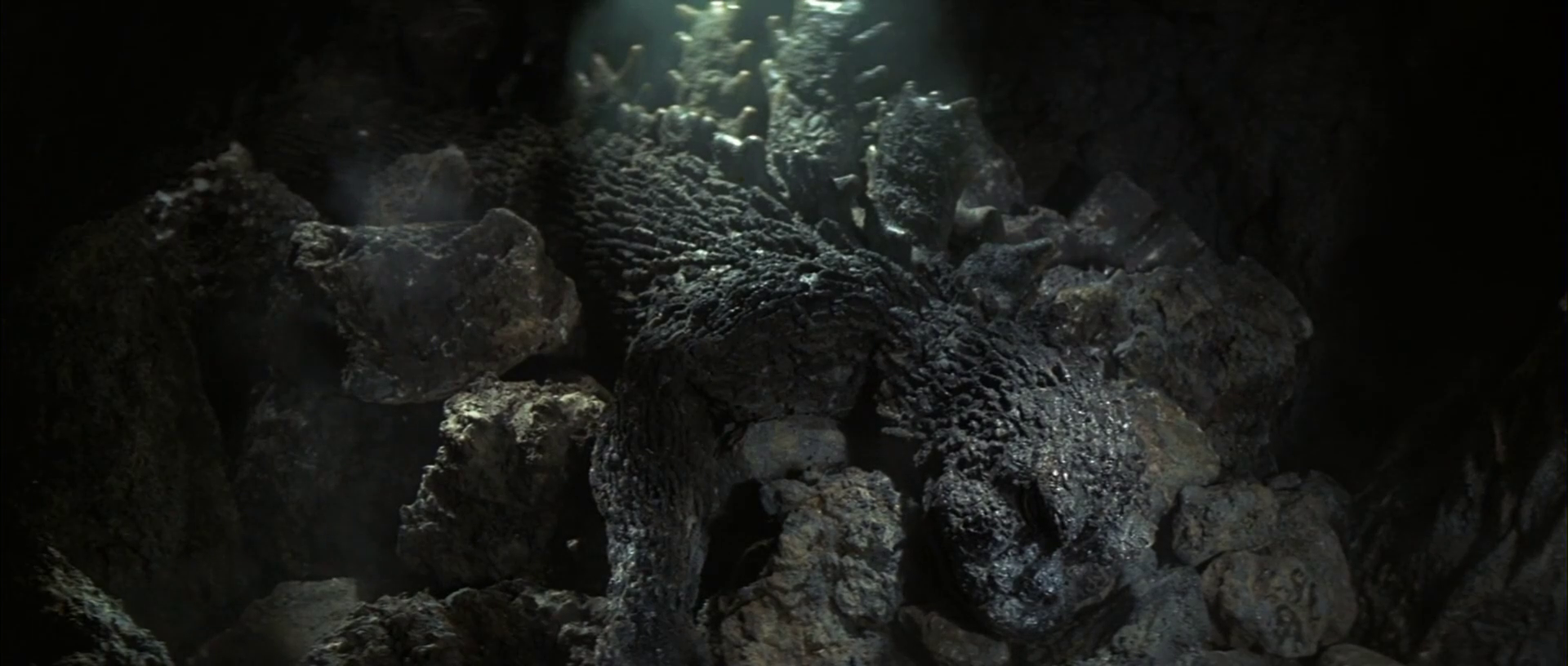
Between battles with Ebirah (the big shrimp mentioned at the beginning of this Report) and some fighter jets, Godzilla takes a rest—at one point, he even appears to be meditating or falling asleep!
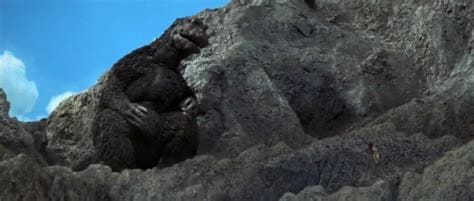
…that is, until a giant, aggressive bird comes out of NOWHERE to pick a fight.
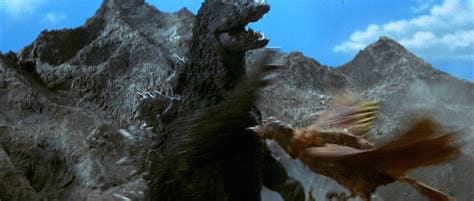
We have been informed that this is the Giant Condor. We do not like him very much.
To illustrate our confusion and frustration, we are including an excerpt from Tex’s Mission Log:
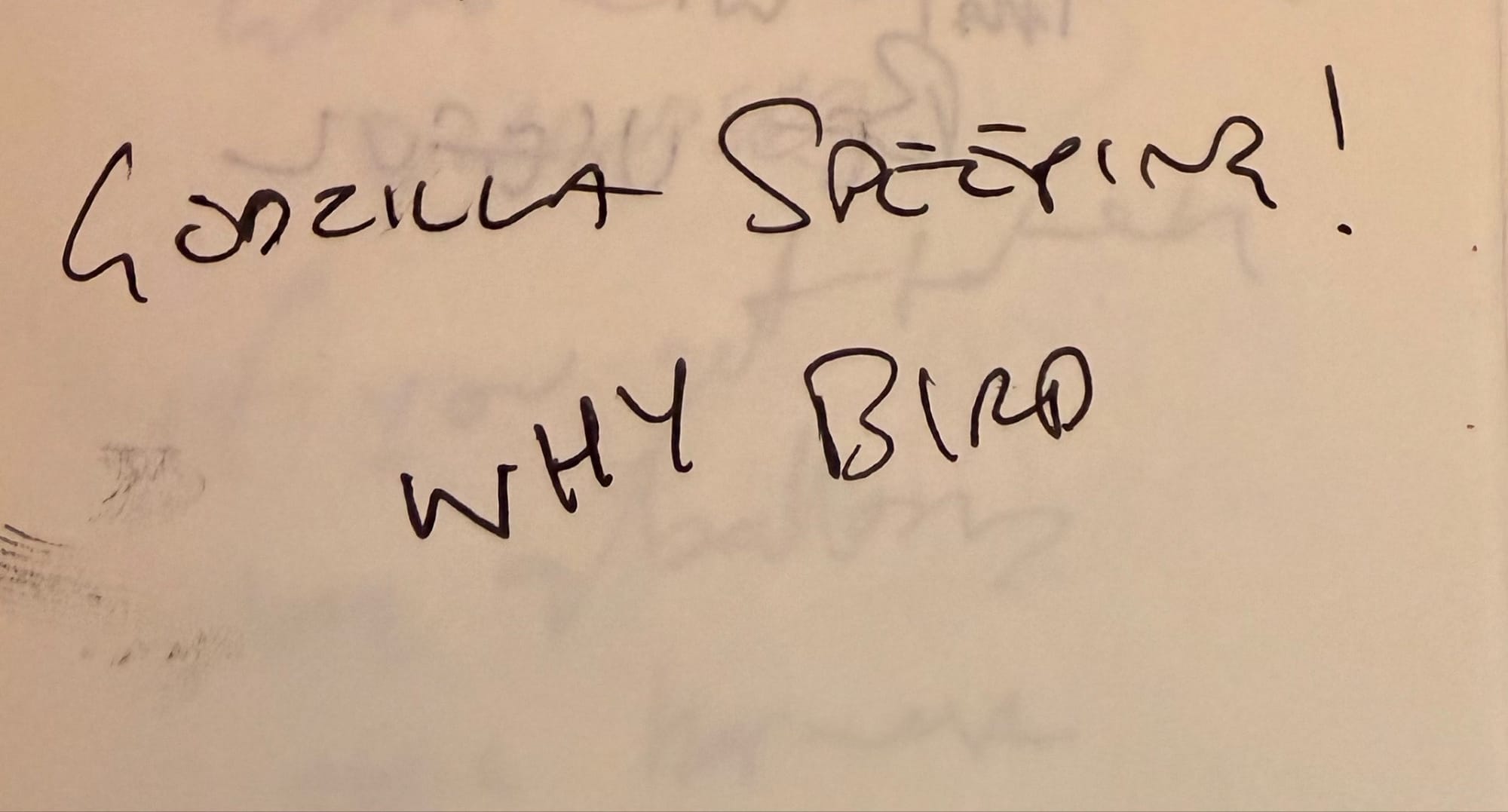
Godzilla defeats both the Giant Rude Bird and Ebirah—he pulls Ebirah’s claws off and snaps them as if to tease Ebirah! What a move! We must note that watching this scene felt akin to watching a demolition derby.
We believe that his victories are due in part to his commitment to rest. We could all take a page from Godzilla’s book and take more naps.
LESSON FOR HUMANITY No. 4: Practice hacky sack
We believe another factor that contributed to Godzilla’s victories is what we are assuming is a strict hacky sack routine. Godzilla’s skills have come a long way since we first witnessed him and Rodan throwing and kicking rocks back and forth in Ghidorah, the Three-Headed Monster (1964)—find our analysis of that artifact here.
While we do not have—as you would call it—”evidence” to substantiate this claim, we put forward this strong hunch based on Egg’s retelling of what he saw during his days in the South Pacific. He was a different Egg then, but we do trust him—even in light of his recent internet faux pa.
LESSON FOR HUMANITY No. 5: Fascists will destroy people and the earth rather than stop oppressing and exploiting people
The aforementioned Red Bamboo enslave the people of Infant Island and force them to toil to produce a chemical that will keep Ebirah at bay while their ships pass (often carrying kidnapped Infant Islanders). At one point, the enslaved Infant Islanders start singing, and the Red Bamboo guards yell: “No singing!”
Right. No singing under fascism.
When confronted with defeat by a sleepy Godzilla, the Red Bamboo opt to trigger a self-destruction process that will destroy evidence of their activity along with the entire island on which they built their violent factory operation. This is a predictable outcome: rather than stop committing violence, the occupying force doubles down and commits as much destruction as possible. We believe this stems from an ideology of supremacy, ownership, and domination. For more on this, we encourage readers to reference Lesson for Humanity No. 1 (Don’t be so Greedy) in Field Report No. 5, which offers lessons from Mothra vs. Godzilla (1964).
We’ve said it before and we will say it again: We are of nature, not separate from it.
We will note that this is the first time during our artifact review where we have seen humans rooting for Godzilla’s safety. In the moments before the island is destroyed, humans are carried to safety by Mothra (who was awakened by dancing and singing—see Lesson for Humanity No. 1). As they fly away, one person laments, “[Godzilla] never meant us any harm.” They yell to Godzilla: “Jump into the water! You’ll be safe there!”
To our collective relief, Godzilla jumps into the water at exactly the right moment.
Rations are well-stocked and morale is improving. We look forward to our next artifact review, which concerns Son of Godzilla (1967). Our working hypothesis: we will cry and think of James Baldwin's quote, "The children are always ours, every single one of them, all over the globe; and I am beginning to suspect that whoever is incapable if recognizing this may be incapable of morality."
The Godzilla Mission Field Office Team
P.S. Tex’s hat got damaged en route to Chicago. Please send funds for a new one. It is embarrassing to appear in public and hope to be taken seriously as a rigorous academic with a dented hat.